Signs of Cancer in Cats: A Symptom-by-Symptom Checklist (and What to Do Next)
Image by Catbreedslist
You're scratching your cat behind the ears the way you always do. Your hand slides down their side, and there it is: a small, firm bump that wasn't there last month. Or maybe it's quieter than that. Your cat is eating a little less, and lately they've been sleeping in the back of the closet instead of on their windowsill.
The signs of cancer in cats slip by us for a reason. Cats are built to hide illness. A sick animal in the wild is an easy meal, and that instinct doesn't switch off just because your cat now has a heated bed and a name. So the warning signs can go unnoticed for weeks, and by then the disease has settled in. Dr. Sue Ettinger, the veterinary oncologist a lot of people know as "Dr. Sue Cancer Vet," puts the lifetime odds at roughly 1 in 5 cats. That number sounds grim. What softens it is this: catching a change early is the piece that's actually in your hands, and early usually means more options on the table.
Below, I'll walk you through what each warning sign really looks like on a cat. Then how to tell an emergency from a wait-and-see, what to jot down before the vet visit, what the appointment itself involves, and where gentle natural support fits in (and where it doesn't).
What Are the Most Common Signs of Cancer in Cats?
The ones that come up most: a new or changing lump, weight loss you can't explain, a shift in appetite, more hiding or flat-out lethargy, and sores that just won't close.
On their own, none of these proves cancer. But if one sticks around past a week or two, that's your cue to book a vet. The trouble with most checklists is they give you the one-word label and leave you to guess what it means. So here's what these signs actually look and feel like on a cat:
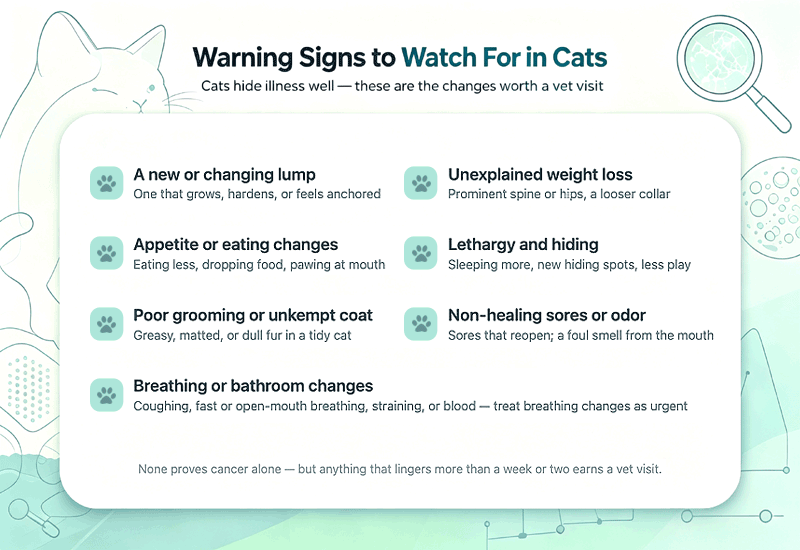
● A new or changing lump. Once a week, run your hands slowly over the belly, chest, mammary chain, down each leg, and along the jaw. You're feeling for anything new, anything that's grown, anything hard, and anything anchored to the tissue underneath instead of sliding around freely. Most lumps turn out to be nothing. A cat tumor that grows, hardens, or roots itself in place is the one you want looked at.
● Lumps or bumps that grow rapidly. (In a week or two.)
● Unexplained weight loss. Sneaky, and easy to miss, because your cat can drop weight while still cleaning the bowl at every meal. Usually your hands catch it before your eyes do. The spine feels sharper under your palm, the hips get bony, the collar slips a notch, and a cat who used to be round starts looking a bit angular. This is where the weekly weigh-in earns its keep.
● Appetite and eating changes. Eating less. Getting fussy. Dropping bits of food, drooling, or pawing at the mouth. A tumor in the mouth or throat often announces itself exactly this way: a cat who clearly wants dinner but can't quite manage it.
● Lethargy and hiding. Sleeping far more than usual. Retreating to closets or corners they never used before. Losing interest in play, or in coming to say hello. For a lot of owners, this shift in behavior is the very first thing they notice.
● Poor grooming and an unkempt coat. A cat who's normally fussy about grooming and suddenly stops, or whose fur turns greasy, matted, or dull, is usually telling you they're in pain or feeling off.
● Non-healing sores, scabs, or odor. Sores that scab, reopen, and won't close, especially on the ears, nose, eyelids, and mouth. And a foul smell from the mouth that isn't just "cat breath" can point to an oral tumor.
● Bathroom changes. Straining in the litter box, blood in the urine or stool, ongoing vomiting or diarrhea, or a belly that looks swollen and distended.
● Breathing changes. Coughing, wheezing, fast breathing while resting, or breathing with the mouth open. Treat any change in breathing as urgent (more on that below).
The Cornell Feline Health Center and PetMD's veterinary reviewers flag these same core cat cancer symptoms. What I've tried to add is the texture. Cancer rarely walks in the front door and announces itself. Mostly what you're catching is your cat quietly drifting off their own normal.
What Are the Early Signs of Cancer in Cats, and Why Are They So Easy to Miss?
Mostly they're behavioral, and mostly they're small. Half a step less energy. A little less interest in dinner. A new spot they've started hiding in. That slow, hard-to-name softening of the personality you know by heart. The early signs of cancer in cats creep in so gradually that "he's just getting old" feels like the obvious explanation, which is precisely the trap. Yes, a senior cat slows down. But a senior cat who suddenly hides all afternoon, turns his nose up at meals, and quits jumping onto the couch isn't just aging, he's showing you a pattern. Chase the pattern down.
And remember that hide-illness instinct. By the time the signs are impossible to ignore, cancer in cats has usually had a head start. Your best defense is knowing your cat's baseline cold: how much they eat, where they sleep, how they move, what the coat feels like under your hand. Know that, and you become an early-warning system no vet can replicate, because no vet sees your cat every day. Age and breed tilt the odds, too. Risk climbs after about age 8, and pale or white cats with sun-exposed ears and noses are more prone to certain skin cancers. You don't have to memorize cancer types. You just have to notice when your cat stops being quite himself, and move on it sooner rather than later.
When Is a Symptom an Emergency vs. Watch-and-Wait?
Some signs mean pick up the phone right now. Others mean book something for later this week and keep watching. Telling the two apart is the difference between spiraling and having a plan.
Call the vet today (or head to an emergency clinic):
● Difficulty breathing, or breathing with the mouth open. Cats almost never open-mouth breathe unless they're in real distress.
● Collapse, or sudden severe weakness. A cat who can't get up or stay standing.
● Straining to urinate with nothing coming out. This one can turn life-threatening within hours.
● Uncontrolled bleeding from a mass, the mouth, or the nose, or a lot of blood in the urine or stool.
● A seizure.
● Not eating for 24 hours, or turning away from water. When a cat stops eating, the liver can get into trouble surprisingly fast.
Book something within a few days (and keep watching) for: a small new lump that isn't growing fast and doesn't seem to bug your cat, a mild dip in appetite that's coming on slowly, a gradual change in behavior with no other red flags, or a little sore you're keeping tabs on.
The rule of thumb I'd hand a friend at 9pm on a weeknight: if it's getting worse quickly, or it's messing with breathing, eating, or peeing, don't wait it out. Everything else still needs a vet, sure. You've just got a bit more room to get there without your stomach in knots.
What Should You Track at Home Before the Vet Visit?
Want to make the appointment count? Show up with data. Your vet will ask a pretty predictable set of questions, and when you can answer them with specifics instead of "um, a while ago?", you get to a diagnosis a lot faster.
1. Date the lump and measure it. Write down the day you first felt it. Photograph it next to a coin for scale, then re-measure once a week so you can show whether it's changing.
2. Weigh your cat weekly. Step on a bathroom scale holding your cat, then again without them, and subtract. For a small cat, a kitchen scale and the carrier works. What matters is the trend over two or three weeks, not any single number.
3. Log appetite and the litter box. Jot down what they eat and how much, plus anything off in the urine or stool: straining, blood, a change in frequency.
4. Photograph any sores. A dated series of photos tells you at a glance whether something is healing, holding steady, or getting worse.
5. Write down behavior changes, with dates. "Started hiding around June 1. Stopped greeting me at the door about a week later." That beats "he's been a bit off lately" every time.
Walk in with all of that and you skip most of the guessing-game appointments and get to the right tests faster.
What Happens at the Vet, and What Does Diagnosis Actually Involve?
It tends to go step by step. A physical exam comes first. Then your vet samples the lump, either with a fine-needle aspirate (a small needle that pulls out a few cells) or a biopsy (which takes an actual piece of tissue, and gives a firmer answer). Bloodwork usually follows, to see how the organs are holding up, and then imaging, an X-ray or an ultrasound, to check whether anything has spread. Some cats then get referred to a veterinary oncologist. Each step is chasing a different answer: is it cancer, what kind is it, and how far has it traveled? Honestly, just knowing the running order ahead of time takes a lot of the dread out of that exam room.
Questions worth asking your vet after testing (biopsy, histopathology exam, x-rays, etc.):
● What type of cancer is this, and where is it?
● Has it spread, and have you been able to stage it?
● What are the treatment options, and is the goal comfort and quality of life or trying to reach remission?
● What does a realistic prognosis look like?
● What can I do at home to support my cat?
Now the money and the waiting, because nobody else says it plainly. In the US, an initial exam plus a fine-needle aspirate or biopsy tends to land somewhere around $200 to $600, depending on your zip code. Add advanced imaging (an ultrasound or CT) and an oncology referral and you can be looking at four figures. Biopsy results usually take anywhere from a few days to a couple of weeks, which is its own special kind of torture. And cost is a genuine worry for most of us, there's zero shame in that. Knowing the ballpark before you walk in means you can ask about payment plans and spend your money on the tests that actually change what you'll do next.
What Can You Do at Home to Support a Cat With Cancer?
The most important support you can give costs nothing: keep your cat eating, keep them comfortable, and stick to the plan your vet sets. Past that, some owners add gentle natural options, and the key is going in with clear eyes about what those can and can't do.
The basics are boring and they matter more than anything fancy. Warm the food up so it smells stronger. Switch to softer textures. Hand-feed a few bites when your cat loses interest. Set up warm, quiet spots to rest, keep fresh water within a few steps of wherever they're sleeping, and don't let the medication schedule or the rechecks slide.
Now the honest part, because you deserve a straight answer. What natural support can do: some pet parents use gentle, natural options to help support their cat's overall wellness and comfort through a hard stretch. What it cannot do: it isn't a cure, and it doesn't replace veterinary treatment. If anyone promises you a natural product will cure your cat's cancer, walk away. Full stop.
Be precise about the science, too, because the claims out there get sloppy. Research published in the US National Library of Medicine (2017) found that the medicinal mushroom Fomitopsis betulina showed antiproliferative properties in laboratory cancer-cell studies. That finding is about the ingredient, in a lab. It is not a promise about any product, and it is not a promise about your individual cat.
Alongside whatever treatment plan your vet recommends, some owners look into gentle, natural options to help support their cat's overall wellness and immune health during this time. One example pet parents explore is natural immune support for cats with cancer, used to support the body's own defenses, not to replace veterinary care.
One rule beats all the rest: whatever you give your cat, tell your vet about it. That's the only way your whole care team stays on the same page.
Frequently Asked Questions
What are the first signs of cancer in cats?
Usually quiet, behavioral ones. The first signs of cancer in cats tend to look like a small dip in energy, a bit less interest in food, a new hiding spot, or weight creeping off even though your cat is still eating. Cats hide illness so well that your best tool is simply knowing their normal baseline, because that's what lets you catch the early shifts before the louder symptoms arrive.
How do cats act when they have cancer?
Cats with cancer often act quieter than usual. You'll see more hiding, less play, more sleep, less grooming so the coat starts to look rough, and smaller meals. These behavior changes are frequently the first thing an owner notices, often before any lump or visible sign turns up at all.
At what age do cats usually get cancer?
Middle age and up is when it shows up most, roughly 8 years and older, though no age is fully off the hook. Certain breeds run a higher risk of particular types, and pale or white cats with sun-exposed ears and noses are the ones to watch for certain skin cancers.
Can a cat survive cancer, and what's the outlook?
It really depends: on the type, on where it is, and above all on how early it's caught, which is the whole reason watching your cat closely pays off. Plenty of cats go on to live well for months or years with treatment, and the odds are best when the cat cancer symptoms get spotted early, before the disease has spread far.
The Bottom Line
You're walking in with more than most owners ever get: a checklist of what each sign really looks like, a way to sort an emergency from a wait-and-watch, a short list to track at home, and a map of the vet visit itself. Catching the signs early and acting on them is genuinely the most powerful thing you can do for your cat.
So keep it practical. If something on this checklist matches what you're seeing at home, call your vet, book the visit, and bring the notes and photos you've been collecting. And where it fits, ask about gentle natural options to support your cat's wellness alongside that care. This guide was put together with Zumalka's team of specialists, who talk with pet parents weighing exactly these decisions every single day. You're not powerless here. The simple fact that you're paying attention is already working in your cat's favor.
You May Also Like
 Cat GroomingTips and Tricks on How to Take Care of Your Cat
 Cat Nutrition & Food10 Kinds of Human Food That Are Good for Cats
 Cat Health & WellnessEvery Important Cats Vaccination Question Answered
 Cat HealthCan Cats Eat Chocolate? The Answer Is an Emphatic "No!"
 Cat BehaviorIf The Cat Is Well Raised, There Will Be These 6 Behaviors!
 Help & Advice6 Taboos Between People And Cats: It's Better Not To Do It!